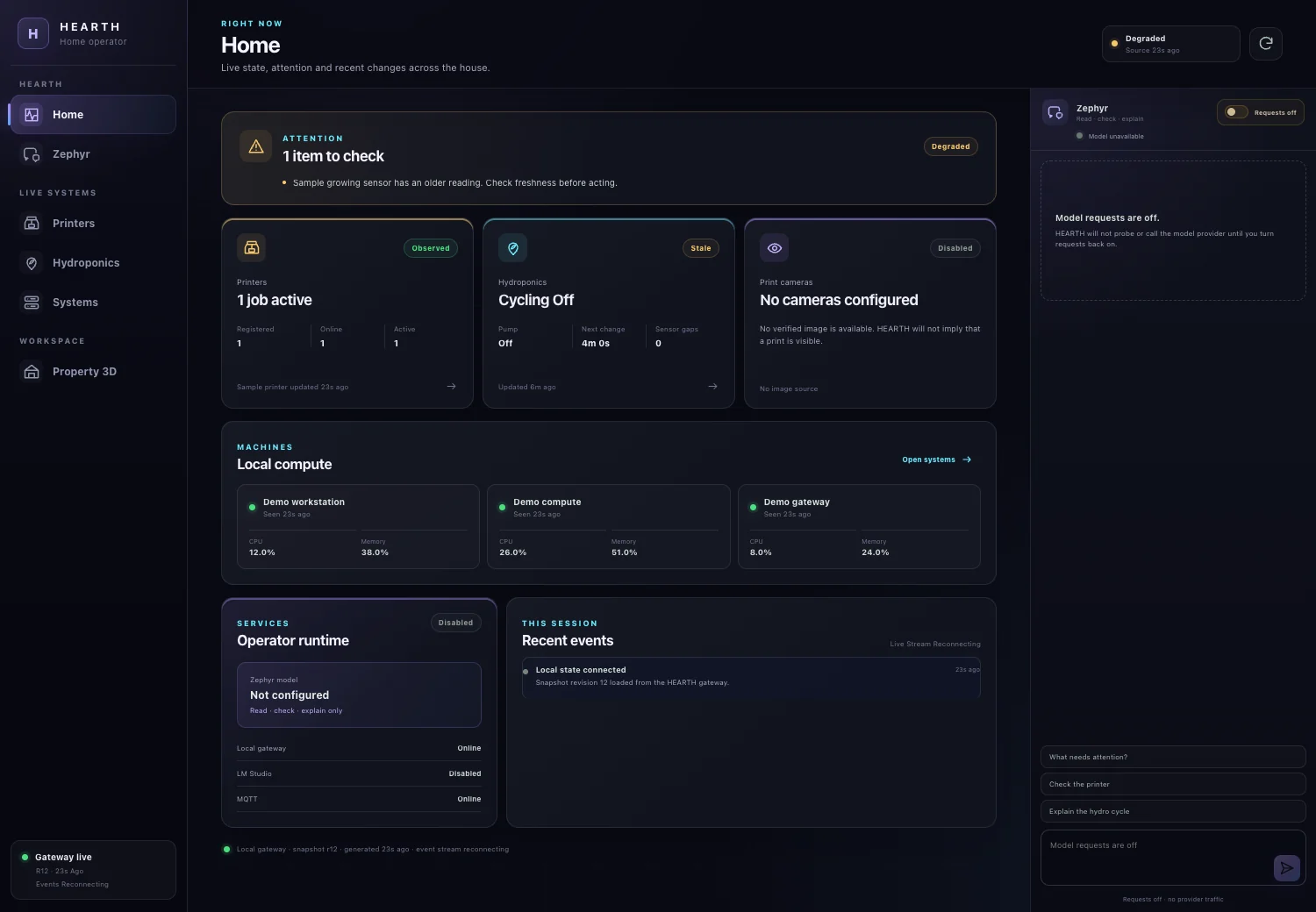
Freshness is part of the answer: a printer is working, a growing sensor is stale, and cameras are unconfigured.
About this image
Real interface · isolated sample telemetry · 7 September 2026 Revision: Image 13cd2c4e88a4 · source base 902400bd60b7 (working tree)
The problem
Printers, growing systems and small devices each report their own version of what is happening. Bringing those readings together is only useful if I can tell what needs attention, where it happened and whether the information is still current.
What I built
A local telemetry and service layer, a browser console, native companion apps and a developing spatial property map, connected to real workshop and household devices.
The interesting part
The difficult part is deciding what a device reading actually means—and how much authority an interface or assistant should receive.
My contribution
Project creator responsible for device integration, local services and interfaces that make household state understandable.
Evidence
Real console captures using isolated sample telemetry, with documented printer, display and growing-system integrations.
Access
Private source and household system. The portfolio shows selected interfaces and architecture, without exposing household readings or device access.
My decisions & how it was built +
What I own
I connect household devices and local services, define what their observations mean, and design interfaces that show what needs attention.
A decision I made
I moved authentication and sessions onto the local host, keeping ownership of household identity in HEARTH while the remote connection carries traffic.
What it builds on
The integrations reuse MQTT messaging, OctoPrint printer status and existing device hardware. SwiftUI and React/Vite support the interfaces; HEARTH supplies the shared observations and access rules.
01 / The work
From a sensor to a useful response.
Useful attention, across very different devices.
HEARTH grew around practical things: a printer enclosure, growing systems, small displays, desktop status and local speech. Those devices produce plenty of information. The harder question is which information should interrupt a person, which should remain available on demand, and which is too old to trust.
That changes the interface. An active print belongs near the top. An idle machine still needs a place in the workshop inventory, but it does not need to dominate the home screen. A stale sensor must remain visibly stale even when its last value looks reassuring.
One reading can reach several surfaces.
A documented printer-enclosure integration uses an M5 Dial with an environmental sensor, printer status arriving through OctoPrint, and MQTT messages carrying readings between local components. E-ink and TFT displays, the mobile interface and spoken announcements can reuse the same information.
The point is to avoid building a separate interpretation for every screen. The local service layer records observations, their source and their time; each client can then present the part that makes sense for its setting. Printer observation remains separate from permission to operate the printer.
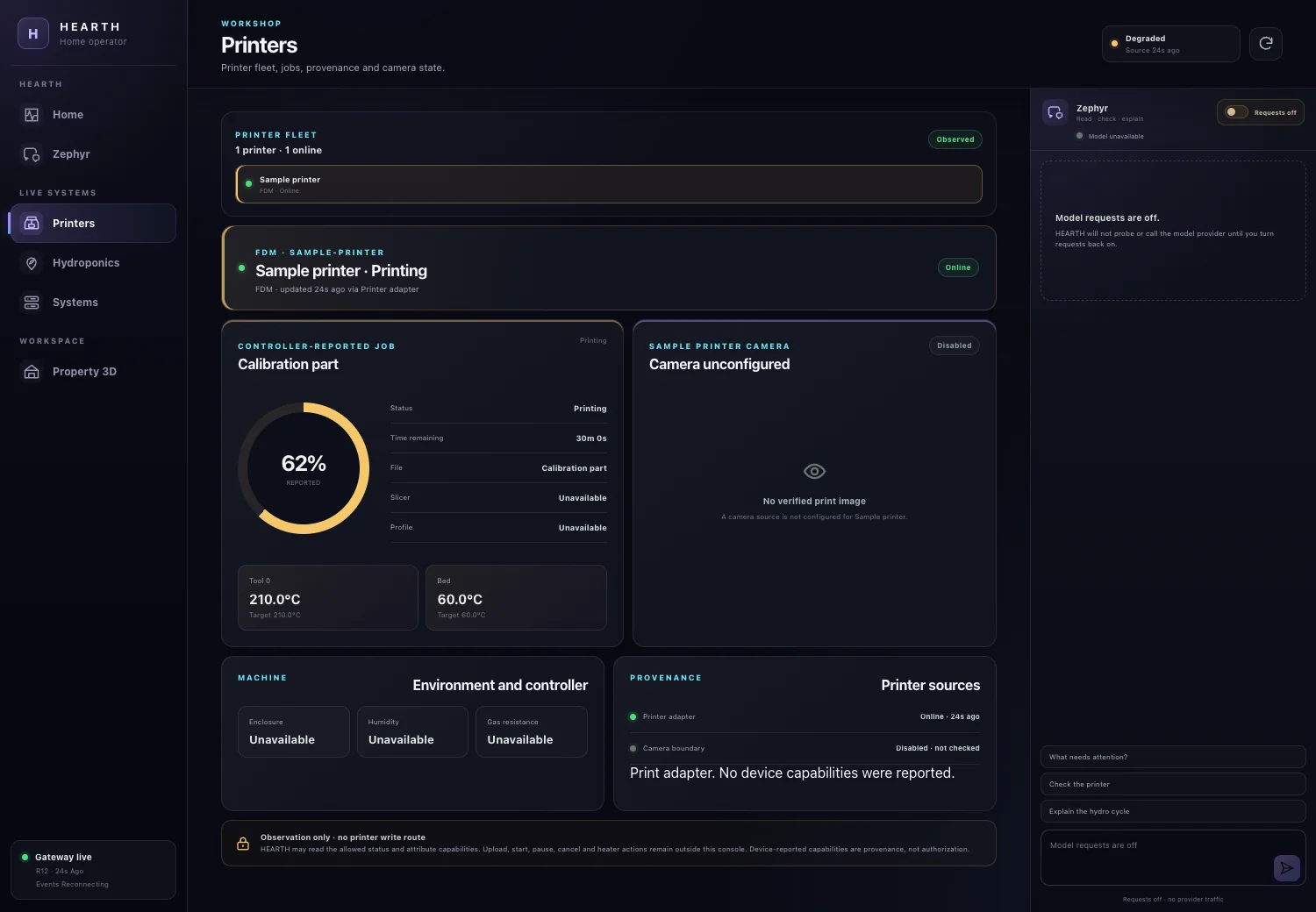
The printer view puts the reported job, temperatures and source state together. This console is observation-only.
About this image
Real interface · isolated sample telemetry · 7 September 2026 Revision: Image 9a1c4c89904e · source base 902400bd60b7 (working tree)
A home view and an inventory serve different jobs.
The newer native Home app makes activity the organising principle. A printing or paused machine can become a large card on Home. Build keeps the complete printer inventory, including idle and offline machines. The interface makes those states available without turning every absent device into an alert.
The broader property-map work explores another kind of context: placing devices within rooms, zones and outdoor areas. That map is a developing interface over shared identities, not evidence that every lighting or environmental integration is already commissioned.
Local ownership has to include identity.
A first remote-access approach depended on an external identity layer. I replaced that dependency with HEARTH-owned authentication and sessions held on the local host. The outside connection became transport, while the application kept ownership of its data and access decisions.
A second lesson is that observation and command are different products. Being able to explain a printer snapshot does not justify generic access to publish messages or run commands. The next control layer needs named capabilities, fresh state, acknowledgements and a clear record of what happened.
A system for a particular home, still evolving.
The project has working local services, device integrations and browser interfaces. The latest recorded private-dashboard release uses local authentication; an attended owner sign-in and sign-out check is still open. The newer native Home app has been built and its rendered interface checked, but has not been installed and tested on a physical iPhone.
The portfolio captures deliberately use sample telemetry. They demonstrate the interface and its treatment of stale or missing data; they do not establish the current health of household equipment.
How it connects
State travels with its source.
The interface should help someone understand what is known before they act.
01
Local sources
Adapters observe devices and services; telemetry can arrive through MQTT.
02
Console Gateway
Normalise source state, timestamps and freshness into a snapshot revision.
03
Owner console
Show that revision, flag stale data, and let a local assistant read, check and explain.
An information-flow diagram, not a network map. Printer observation grants no printer control; optional model requests have an explicit boundary.Diagram source
Carry source, timestamps and snapshot revision alongside observations so the interface can distinguish a current reading from an old but plausible number.
02
Observe before adding control
Let consoles and assistants inspect normalised state. Add physical actions through explicit device capabilities instead of granting a general message or shell interface.
03
Keep identity and data local
Run authentication, sessions and durable household state on owned hardware. A remote transport should not become the owner of the application.
04 / Iteration
What changed along the way.
Device layer
Start with things that already need watching
Printer telemetry, enclosure sensing, hydroponics, small displays and local announcements established the practical integrations.
Shared state
Give the interfaces one account of events
A console gateway normalises readings and their freshness for browser and companion interfaces. The Home app prioritises active work.
Spatial context
Connect observations to places
The developing property map and place registry add rooms, zones and device placement while preserving the distinction between observation and control.
05 / Under the hood
For the curious.
Architecture, implementation and the details behind the interface.
Device → message → observation+
MQTT carries device telemetry into local services. Historical storage and normalised snapshots support different clients without requiring each screen to interpret raw topics.
Several native surfaces+
The project includes SwiftUI mobile work, a macOS menu-bar client, Pi and Windows clients, and a React/Vite spatial interface. Each surface has its own build and device acceptance boundary.
Assistant boundary+
Local speech, vision and model services can work with bounded context. The console can expose a specific snapshot without implicitly exposing device credentials or unrestricted control.
06 / Current state
Where it stands.
What exists today
HEARTH is a private installation. The images use sample readings; they are not a public control panel or a live view of the home.
Where I’m taking it
Try the locally authenticated dashboard and newer native Home app through the complete owner workflow on the intended devices.
Connect the developing place registry and spatial map to commissioned device observations.
Introduce carefully scoped physical commands with freshness checks, acknowledgements and recovery behaviour.